Sunday, April 24, 2011

Triviality and self importance.

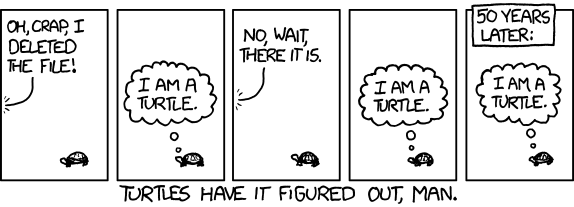
So, I am a daily reader of a multitude of webcomics. This comic is from a popular series called XKCD which I would highly recommend for anyone. I liked this comic because it really highlighted the difference between humanity and the rest of nature. That turtle knows what it is, it knows what it wants, and it doesn't really care about anything beyond itself. While that human is being shown as doing trivial things that in fifty years won't really matter. The turtle as nature shows that in reality, what humanity can accomplish is all just trivial in it's eyes since it cannot judge. Nature is not sentient, it just is. It is uncaring, nonconscious and always changing. The human is performing an action that for a few moments was incredibly important to him then ended. Unlike nature, humanity cares. It cares about it's own problems, trivial and grand. It cares about the future and what is happening. In this I think there is a conflict in humanity because of this. Humanity doesn't like the idea that they are acting without the benefit of having anything on the cosmic scale react and therefore they prefer to personigy nature.

Going along with this, I think that this can explain why humanity can turn to religion. Religion, especially Western religion, preaches of all powerful benevolent beings that care about every person. This gives nature a caring face that is actually very interested in the wellbeing of humanity. This is truly what religion does for a lot of people. It allows people to believe that there is something greater than them.
You know, I just realized I have inferred a lot from a comic that only depicts a turtle. I wonder If I overanalysed this.

Q: Why do humans feel the need to always have recognition from something superior? Be it god, a boss, or simply one's role model or hero?

Government

Q:Would you sacrifice the ideals of capitalism for another economic system?
-Israel Diaz

A: I would only sacrifice the ideals of capitalism if and only if there was another economic system that would be better. I do not hold any emotional attachment to concepts such as systems. In my opinion, if there is another system that would improve the economy and government, we should go full steam ahead. Now saying this, it is indeed proven that capitalism is indeed a flawed system. Pure capitalism holds the risk of monopolies and the possibility of taking over the government. So, if this is the case, should it not be the logical choice to make changes to the economic system? Although the reason changes aren't being implemented  is probably mostly due to the corporations taking control of the government, I am sure a part of this unwillingness to change has to do with the idea that capitalism is somehow the only way to run an economy. Capitalism is good, Capitalism is right, Capitalism is Patriotic! 

Q: Why is it that we view capitalism as morally correct and the only proper way? What are the reasons that make us unwilling to change this system?

Sunday, April 17, 2011

Q: Do you find people more attractive because of their looks or their personalities upon first impression? Most people make an initial impression of someone based on their looks. Do you agree or disagree with this? Why are looks, and not other qualities such as intelligence and compassion, most highly valued in our society? -Julia Ashton


A: It is instinctual to judge someone off of their appearances on first impression. It is very hard to judge someone's personality, intelligence, sense of humor, or any other nonphysical trait for one's first encounter. However, I would not say that looks are the pinnacle of value in america (Yet. Give MTV a few more years). It is an old saying that my grandmother told my mom: It is the looks that draw the man in, but the personality that keeps him. This is why relationships that are built only on physical lust, rarely last long or get real personal unless there is some other non-physical aspect that the couple share. However, to answer the question on why looks are valued in the first place, there are many reasons. To start off, when one looks appealing, it shows one cares enough to look nice. This is why one dresses up on job interviews and dates. Also, from an evolutionary perspective, When one is physically attractive, that means that one is one is a good potential mate to help create offspring and pass down one's genetic material. Also, by one's stance, hygeine, and even sense in fashion, one can get a mild read on a persons personality, which is why people look for clothes that express themselves and their personality.


Q: Can clothing and stylish trends ever be able to reveal to an observer one's true personality? If so, is it more the clothing that conveys this personality, or is it the observer who is able to pick up on one's personality?

Biology and Government

So, yet another link now. I stumbled upon this article this week about how the biology in one's brain can influence one's own political leanings. Apparently, liberals have a larger anterior cingulate cortex, which is heavily involved in decision making, while the conservative brain has a slightly larger amygdala, which is linked to emotional learning and precessing fear. This might explain why there is much difficulty trying to reach across parties, because the opposing party is actually wired differently. 
This also brings up some interesting questions and consequences. For example:
Do we have any control over our political leanings?
If there truly is a biological difference in ones political position, does that mean that anyone can be blamed or be told that they are wrong for their political viewpoint?

Sunday, April 10, 2011

Beauty

Q: In what other ways do humans twist what is natural to seem more appealing?
-Brittany Guntor.


A: I think that humanity has done this the most with the natural concept of beauty. Beauty is said to be found in nature, and what humanity does is think that we can 'improve' or 'add' onto this natural beauty. I would not claim that humanity twists this beauty however, since to twist is synonymous with to corrupt. But what humanity does do, is change or mold this beauty. It is often viewed that since we change this beauty to our preferences, we twist it, but in reality, all we are doing is changing it. 
However, I do agree that sometimes one can go to far with the need to change things to increase their beauty, and mainly they do this with the body. Women inject venom into their face to appear younger, people spend thousands of dollars on surgery to thin oneself out or enlarge one's breast, men take steroids to appear stronger and more attractive. People starve themselves or undergo many forms of abuse in order to increase their beauty. However, now we are verging on the difference between attractiveness and beauty. 
Q: Is there a difference between attraction and beauty?
Q: Why do we believe that if one changes nature to suit one's desire, one is perverting nature?

Empathy

       After talking about the horrible things people do in class. I wondered, what could cause people to try to actually hurt other people so they can make a buck. Later during the week, I happened to stumble upon an article that discussed the root of all evil. The scientist, Simon Baron-Cohen, talks about how he believes that the source of all evil is simply a lack of empathy. He discusses how he wishes that his advances in science will be able to influence Ethics and Morality and provide more evidence for discussion. Naturally, since greed has been on my mind since we continually talked about wall street and the government.
       Even though the article talks mainly about evils such as killing and genocide, this can definitely apply for greed. However, if greed is merely the lack of empathy for others, that would mean the more one desires objects, the less empathy one possesses. But, there is a very fine line between trying to gain possessions and actual greed, and at a certain point, it does cross that line from desire to greed. Although that line is not known, people can recognize when it is passed.

Question: Does that mean that since the more one desires, the less empathy one possesses? If that is the case, does the desire to earn money and live a life of comfort mean one has less empathy for other beings.

Sunday, April 3, 2011

Labels

Q: Do you feel as if we HAVE to label ourselves an agnostic, atheist, or theist?

A: Yes, I believe as if we do have to label ourselves as one of these three options. It is impossible for one to not have an opinion in a subject as big and important as God (In fact, I don't believe it is possible for anyone to have no opinion on any certain topic, but that is not for here.) One must either believe in, be unsure of (or not know, or have doubts on), or not simply not believe in the existence of God. It is impossible for someone to not hold one of these opinions, and therefore can be classified as whatever it is that they believe in. I do view however that sometimes people can be unsure of what their opinion is on the subject, and until they figure it out, one should not be classified. That is the only exception I can think of as to when a person should not be classified. 

Do you think that labels will confine us and make us stay within their boundaries?

What others think.

Why do people care so much what other people think? When it comes to politics or economics, I can understand why people care so much since they believe that if the other person has differing viewpoints, then they would do more harm than good since they wouldn't know your beliefs. But as far as religion or philosophy goes, why do people care so much about what others think or believe? Hell, why do people argue when they find out someone else doesn't like a book or movie that they happen to enjoy it?
 I believe it has to do mainly with one's own personal investment in the item that there is a disagreement about. I think that if one has a formed opinion on a subject, upon hearing that somebody holds a different opinion, one subconsciously, or possibly consciously views that as an attack on their own opinion and their confidence because humans want to be sure in their ideas and don't like doubt, which is exactly what differing opinions cause. Therefore, the only way to counteract this is by arguing your opponent into submission and therefore discounting his opinion and securing our own. In this manner, we are not doing this to change his beliefs, but to secure our own.