Seeing that this one is my last post for the semester, I would first off like to say that you to my classmates that participated in class and on the blogs to provide interesting conversation. I really enjoyed discussing these philosophical questions with you. Also, I would like to thank David Johnson for being an amazing professor and finding interesting material for us to read and talk about. Although you tended to go on monologuing at points (Kidding, sorta :p), You really brought new ideas that I never considered and I loved thinking about. I can't wait to have philosophy of music with you next semester.
Now, onto the actual part of the post that talks about human nature. Since this is the goodbye, I thought I would talk about death, since they both have to do with parting. I have been thinking for a while and was wondering which people fear more, death, or dying. My mom always says that she doesn't fear death, but she fears dying. Death is the fear of the actual oblivion, while fear of dying is the fear of the process that results in death. but then I thought about things that the reason one probably fears dying is because they fear the fact that their body will fail them, which will result in the oblivion, so in a way they are the same. Fear of dying is just fear of death, just once removed.
Which do you fear, death or dying?
(Thanks for everything again. Have a great summer all of you)
Sunday, May 15, 2011

Response to Julia's question
Q: Do you think it is ever possible for someone to truly live selflessly, always putting others before their own, or will their own interests always take priority over that of others?-Julia Ashton
A: It depends on what one means when one talks about selflessness. If one means that one puts others before them, then I would claim that the answer is no. However, if youy mean that one holds more interests in helping others for personal reasons, then I would say yes. This reminds me of that essay we had to read when we talked about altruism, where although one might not be able to act outside of one's own 'want,' one can still channel that 'want' into the wellbeing of others.
Q: The question I have is, is one morally obliged to be selfless?
A: It depends on what one means when one talks about selflessness. If one means that one puts others before them, then I would claim that the answer is no. However, if youy mean that one holds more interests in helping others for personal reasons, then I would say yes. This reminds me of that essay we had to read when we talked about altruism, where although one might not be able to act outside of one's own 'want,' one can still channel that 'want' into the wellbeing of others.
Q: The question I have is, is one morally obliged to be selfless?
Nature or Nurture.
Since I should be studying for a behavior analysis final tomorrow, I think I might as well write a blog post on the behaviorist perspective perspective on human nature. Behaviorism is a psychological theory that believes that all human behavior, thought, and action (actually, thought and action are a part of behavior) are influenced only by environmental stimuli and conditioning. They leave room for genetic influences and disabilities, but beyond that, all human behavior can be traced back to environmental influences. It is an interesting theory to say the least, because they believe that with the right environmental stimuli a human can learn to act or behave in almost any way. People often use behaviorist theories and techniques to treat people with mental deficiencies, suffering from phobias or other mental problems.
The philosophical problem comes when one realizes that through this theories, not only is there no free will, but one is merely a puppet to external forces. What is scarier is that more and more evidence is pointing to the fact that this might be the truth.
For those that are interested, one can read more here:
http://plato.stanford.edu/entries/behaviorism/
The philosophical problem comes when one realizes that through this theories, not only is there no free will, but one is merely a puppet to external forces. What is scarier is that more and more evidence is pointing to the fact that this might be the truth.
For those that are interested, one can read more here:
http://plato.stanford.edu/entries/behaviorism/
Human nature and sexuality
It struck me that we completely neglected a large facet of human nature. Human love and sexuality. What is love? What kinds of love are there? What fetishes are acceptable? Is homosexuality natural? Does one learn to love? Is homosexuality wrong? What kind of love is acceptable?
Because I viewed that We neglected this aspect, I thought I'd just get a brief overview of the theories behind them.
http://www.iep.utm.edu/love/
http://www.iep.utm.edu/sexualit/
These I viewed were great summaries of the ideas behind them. Although I just skimmed and read the parts that interested me, I found them quite informative. So in order to breed some possible discussion on this concept (although I doubt anybody is going to respond to this, my question is, what do you think love is?
Because I viewed that We neglected this aspect, I thought I'd just get a brief overview of the theories behind them.
http://www.iep.utm.edu/love/
http://www.iep.utm.edu/sexualit/
These I viewed were great summaries of the ideas behind them. Although I just skimmed and read the parts that interested me, I found them quite informative. So in order to breed some possible discussion on this concept (although I doubt anybody is going to respond to this, my question is, what do you think love is?
Free will?
So, according to this article, there is a drug called burundanga, which is rumored to possibly be able to take away a persons free will, which raises great inquiries about free will and the neurology that allows us to possess it, if we do indeed have it. If there is a plant that can shut off one's free will, then that instantly eliminates the possibility of the soul existing. Because only something physical can be affected by something physical, that negates the possibility of the soul.
Another interesting thing this article brings up is the possibility that certain chemicals can tamper with our 'free will' which means that our free will could be easily influenced and manipulated. Could our will be not as free as we thought?
Another interesting thing this article brings up is the possibility that certain chemicals can tamper with our 'free will' which means that our free will could be easily influenced and manipulated. Could our will be not as free as we thought?
Sunday, May 1, 2011
Celebration of death
So, as most of you already The death of Osama Bin Laden was confirmed by president Obama on May 1st 2011. And upon the release of this news, many places I go to online (*cough* Facebook *cough*) has exploded in expressions of celebration, skepticism and debate. However, one of the biggest arguments I encountered was the debate over whether or not one should feel happy about the murder. People are celebrating the death, saying 'good riddance' and 'thank God,' while others are claiming that it was a bad thing that he was murdered. Often they say that his death was not worth the amount of lives needed to kill him.
However, I notice that there is a flaw in the logic of the objectors. What they claim is that his death was not worth the cost. While the celebrators are just celebrating the fact that a dangerous enemy that killed many people is gone. The objectors and celebrators are discussing two completely different things. I am sure that most of the celebrators would agree that the life cost was too high in order to finally get him, but that is not the point. The point is that he is out of the way finally and can do no more direct damage (however he might inspire a couple terrorists who make him out to be a martyr).If the objectors truly wished to argue this case, then they would need to argue more along the lines of how murder and death is always wrong no matter what, but I am sure defending a terrorist who killed thousands of people and promoted hatred and violence won't go over very well.
Is it alright to celebrate the death of an enemy?
However, I notice that there is a flaw in the logic of the objectors. What they claim is that his death was not worth the cost. While the celebrators are just celebrating the fact that a dangerous enemy that killed many people is gone. The objectors and celebrators are discussing two completely different things. I am sure that most of the celebrators would agree that the life cost was too high in order to finally get him, but that is not the point. The point is that he is out of the way finally and can do no more direct damage (however he might inspire a couple terrorists who make him out to be a martyr).If the objectors truly wished to argue this case, then they would need to argue more along the lines of how murder and death is always wrong no matter what, but I am sure defending a terrorist who killed thousands of people and promoted hatred and violence won't go over very well.
Is it alright to celebrate the death of an enemy?
Response to Julia
Have you ever been able to meditate? If so, how do you think it works? How are we able to disconnect our mental body from our physical body?-Julia Ashton
To answer that question, yes, I have entered meditative states on multiple occasions. I have also gone through guided meditation and hypnosis. All in my opinion are very similar. From my viewpoint, meditation is all about bringing oneself to a different state of consciousness and focusing one's concentration and focus on certain concepts. It can be self improvement, or contemplation. It is very relaxing and can often help me personally get in touch with my own self, imagination, and willpower. It allows me to focus my energy on the object that I want accomplished for that session, and even if I don't get it accomplished, it provides me with a great way of relaxing. As for how it can separate your mind from the body, it is just like anything else that requires a lot of intense focus and concentration. When you focus your mind on one specific task, you only pay attention to the parts of your body and environment that you need. Therefore, when one is only using one's mind, the rest of the body fades out and 'disconnects' with us.
If the mind can do such amazing things like tune out the entire body and focus solely on the mind, could the reverse be true? Could the mind ever focus solely on the body and completely shut off the conscious mind?
Sunday, April 24, 2011
Triviality and self importance.
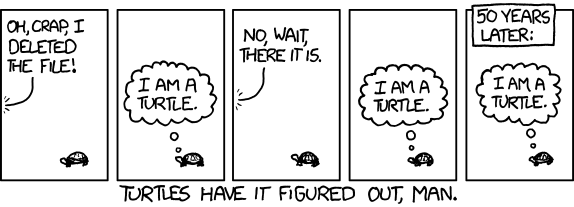
Going along with this, I think that this can explain why humanity can turn to religion. Religion, especially Western religion, preaches of all powerful benevolent beings that care about every person. This gives nature a caring face that is actually very interested in the wellbeing of humanity. This is truly what religion does for a lot of people. It allows people to believe that there is something greater than them.
You know, I just realized I have inferred a lot from a comic that only depicts a turtle. I wonder If I overanalysed this.
Q: Why do humans feel the need to always have recognition from something superior? Be it god, a boss, or simply one's role model or hero?
Government
Q:Would you sacrifice the ideals of capitalism for another economic system?
-Israel Diaz
A: I would only sacrifice the ideals of capitalism if and only if there was another economic system that would be better. I do not hold any emotional attachment to concepts such as systems. In my opinion, if there is another system that would improve the economy and government, we should go full steam ahead. Now saying this, it is indeed proven that capitalism is indeed a flawed system. Pure capitalism holds the risk of monopolies and the possibility of taking over the government. So, if this is the case, should it not be the logical choice to make changes to the economic system? Although the reason changes aren't being implemented is probably mostly due to the corporations taking control of the government, I am sure a part of this unwillingness to change has to do with the idea that capitalism is somehow the only way to run an economy. Capitalism is good, Capitalism is right, Capitalism is Patriotic!
Q: Why is it that we view capitalism as morally correct and the only proper way? What are the reasons that make us unwilling to change this system?
Sunday, April 17, 2011
Q: Do you find people more attractive because of their looks or their personalities upon first impression? Most people make an initial impression of someone based on their looks. Do you agree or disagree with this? Why are looks, and not other qualities such as intelligence and compassion, most highly valued in our society? -Julia Ashton
A: It is instinctual to judge someone off of their appearances on first impression. It is very hard to judge someone's personality, intelligence, sense of humor, or any other nonphysical trait for one's first encounter. However, I would not say that looks are the pinnacle of value in america (Yet. Give MTV a few more years). It is an old saying that my grandmother told my mom: It is the looks that draw the man in, but the personality that keeps him. This is why relationships that are built only on physical lust, rarely last long or get real personal unless there is some other non-physical aspect that the couple share. However, to answer the question on why looks are valued in the first place, there are many reasons. To start off, when one looks appealing, it shows one cares enough to look nice. This is why one dresses up on job interviews and dates. Also, from an evolutionary perspective, When one is physically attractive, that means that one is one is a good potential mate to help create offspring and pass down one's genetic material. Also, by one's stance, hygeine, and even sense in fashion, one can get a mild read on a persons personality, which is why people look for clothes that express themselves and their personality.
Q: Can clothing and stylish trends ever be able to reveal to an observer one's true personality? If so, is it more the clothing that conveys this personality, or is it the observer who is able to pick up on one's personality?
A: It is instinctual to judge someone off of their appearances on first impression. It is very hard to judge someone's personality, intelligence, sense of humor, or any other nonphysical trait for one's first encounter. However, I would not say that looks are the pinnacle of value in america (Yet. Give MTV a few more years). It is an old saying that my grandmother told my mom: It is the looks that draw the man in, but the personality that keeps him. This is why relationships that are built only on physical lust, rarely last long or get real personal unless there is some other non-physical aspect that the couple share. However, to answer the question on why looks are valued in the first place, there are many reasons. To start off, when one looks appealing, it shows one cares enough to look nice. This is why one dresses up on job interviews and dates. Also, from an evolutionary perspective, When one is physically attractive, that means that one is one is a good potential mate to help create offspring and pass down one's genetic material. Also, by one's stance, hygeine, and even sense in fashion, one can get a mild read on a persons personality, which is why people look for clothes that express themselves and their personality.
Q: Can clothing and stylish trends ever be able to reveal to an observer one's true personality? If so, is it more the clothing that conveys this personality, or is it the observer who is able to pick up on one's personality?
Biology and Government
So, yet another link now. I stumbled upon this article this week about how the biology in one's brain can influence one's own political leanings. Apparently, liberals have a larger anterior cingulate cortex, which is heavily involved in decision making, while the conservative brain has a slightly larger amygdala, which is linked to emotional learning and precessing fear. This might explain why there is much difficulty trying to reach across parties, because the opposing party is actually wired differently.
This also brings up some interesting questions and consequences. For example:
Do we have any control over our political leanings?
If there truly is a biological difference in ones political position, does that mean that anyone can be blamed or be told that they are wrong for their political viewpoint?
This also brings up some interesting questions and consequences. For example:
Do we have any control over our political leanings?
If there truly is a biological difference in ones political position, does that mean that anyone can be blamed or be told that they are wrong for their political viewpoint?
Sunday, April 10, 2011
Beauty
Q: In what other ways do humans twist what is natural to seem more appealing?
-Brittany Guntor.
A: I think that humanity has done this the most with the natural concept of beauty. Beauty is said to be found in nature, and what humanity does is think that we can 'improve' or 'add' onto this natural beauty. I would not claim that humanity twists this beauty however, since to twist is synonymous with to corrupt. But what humanity does do, is change or mold this beauty. It is often viewed that since we change this beauty to our preferences, we twist it, but in reality, all we are doing is changing it.
However, I do agree that sometimes one can go to far with the need to change things to increase their beauty, and mainly they do this with the body. Women inject venom into their face to appear younger, people spend thousands of dollars on surgery to thin oneself out or enlarge one's breast, men take steroids to appear stronger and more attractive. People starve themselves or undergo many forms of abuse in order to increase their beauty. However, now we are verging on the difference between attractiveness and beauty.
Q: Is there a difference between attraction and beauty?
Q: Why do we believe that if one changes nature to suit one's desire, one is perverting nature?
-Brittany Guntor.
A: I think that humanity has done this the most with the natural concept of beauty. Beauty is said to be found in nature, and what humanity does is think that we can 'improve' or 'add' onto this natural beauty. I would not claim that humanity twists this beauty however, since to twist is synonymous with to corrupt. But what humanity does do, is change or mold this beauty. It is often viewed that since we change this beauty to our preferences, we twist it, but in reality, all we are doing is changing it.
However, I do agree that sometimes one can go to far with the need to change things to increase their beauty, and mainly they do this with the body. Women inject venom into their face to appear younger, people spend thousands of dollars on surgery to thin oneself out or enlarge one's breast, men take steroids to appear stronger and more attractive. People starve themselves or undergo many forms of abuse in order to increase their beauty. However, now we are verging on the difference between attractiveness and beauty.
Q: Is there a difference between attraction and beauty?
Q: Why do we believe that if one changes nature to suit one's desire, one is perverting nature?
Empathy
After talking about the horrible things people do in class. I wondered, what could cause people to try to actually hurt other people so they can make a buck. Later during the week, I happened to stumble upon an article that discussed the root of all evil. The scientist, Simon Baron-Cohen, talks about how he believes that the source of all evil is simply a lack of empathy. He discusses how he wishes that his advances in science will be able to influence Ethics and Morality and provide more evidence for discussion. Naturally, since greed has been on my mind since we continually talked about wall street and the government.
Even though the article talks mainly about evils such as killing and genocide, this can definitely apply for greed. However, if greed is merely the lack of empathy for others, that would mean the more one desires objects, the less empathy one possesses. But, there is a very fine line between trying to gain possessions and actual greed, and at a certain point, it does cross that line from desire to greed. Although that line is not known, people can recognize when it is passed.
Question: Does that mean that since the more one desires, the less empathy one possesses? If that is the case, does the desire to earn money and live a life of comfort mean one has less empathy for other beings.
Even though the article talks mainly about evils such as killing and genocide, this can definitely apply for greed. However, if greed is merely the lack of empathy for others, that would mean the more one desires objects, the less empathy one possesses. But, there is a very fine line between trying to gain possessions and actual greed, and at a certain point, it does cross that line from desire to greed. Although that line is not known, people can recognize when it is passed.
Question: Does that mean that since the more one desires, the less empathy one possesses? If that is the case, does the desire to earn money and live a life of comfort mean one has less empathy for other beings.
Sunday, April 3, 2011
Labels
Q: Do you feel as if we HAVE to label ourselves an agnostic, atheist, or theist?
A: Yes, I believe as if we do have to label ourselves as one of these three options. It is impossible for one to not have an opinion in a subject as big and important as God (In fact, I don't believe it is possible for anyone to have no opinion on any certain topic, but that is not for here.) One must either believe in, be unsure of (or not know, or have doubts on), or not simply not believe in the existence of God. It is impossible for someone to not hold one of these opinions, and therefore can be classified as whatever it is that they believe in. I do view however that sometimes people can be unsure of what their opinion is on the subject, and until they figure it out, one should not be classified. That is the only exception I can think of as to when a person should not be classified.
Do you think that labels will confine us and make us stay within their boundaries?
What others think.
Why do people care so much what other people think? When it comes to politics or economics, I can understand why people care so much since they believe that if the other person has differing viewpoints, then they would do more harm than good since they wouldn't know your beliefs. But as far as religion or philosophy goes, why do people care so much about what others think or believe? Hell, why do people argue when they find out someone else doesn't like a book or movie that they happen to enjoy it?
I believe it has to do mainly with one's own personal investment in the item that there is a disagreement about. I think that if one has a formed opinion on a subject, upon hearing that somebody holds a different opinion, one subconsciously, or possibly consciously views that as an attack on their own opinion and their confidence because humans want to be sure in their ideas and don't like doubt, which is exactly what differing opinions cause. Therefore, the only way to counteract this is by arguing your opponent into submission and therefore discounting his opinion and securing our own. In this manner, we are not doing this to change his beliefs, but to secure our own.
I believe it has to do mainly with one's own personal investment in the item that there is a disagreement about. I think that if one has a formed opinion on a subject, upon hearing that somebody holds a different opinion, one subconsciously, or possibly consciously views that as an attack on their own opinion and their confidence because humans want to be sure in their ideas and don't like doubt, which is exactly what differing opinions cause. Therefore, the only way to counteract this is by arguing your opponent into submission and therefore discounting his opinion and securing our own. In this manner, we are not doing this to change his beliefs, but to secure our own.
Sunday, March 27, 2011
Procrastination
In order to survive, man needs to perform certain tasks, like work for money, or buy groceries for food. Yet it is a part of human nature to do what one desires, such as play a game of football, surf the web, or read a book. So obviously, some things that are neccessary conflict with thing that we want to do. Now, it is in everybody's best option if one does the things that will keep one alive longer and inrease one's chance of survival. Yet we have things like procrastination, and neglect which make us not do these things.
Why is it a part of human nature to have humans neglect the things that will increase their survival rates?
Is it ok to be selfish on the path to your dreams if your dream is an altruistic one?
-By Cameron Hamlet
-I find this question to be very interesting. I would have to say the answer lies wit the person and how far they are willing to go to pursue their dreams. A dream is a goal or an object that someone wishes to attain. Everybody has dreams and everybody wants to achieve them. The question one must ask is 'what is one willing to do to achieve ones dreams?" A dream usually makes someone happy and is desirable, would one not wish to then do everything in one's power to achieve it? Also, the American way and culture is stereotypically created so one can pursue one's dreams. Therefore it is not bad to pursue dreams. So, if to achieve ones goals is highly desirable, and is morally acceptable, the only thing that could stop one from achieving it is one's conscience.
As long as one does not break any personal or social mores, then one will not have done anything morally impermissible.
-By Cameron Hamlet
-I find this question to be very interesting. I would have to say the answer lies wit the person and how far they are willing to go to pursue their dreams. A dream is a goal or an object that someone wishes to attain. Everybody has dreams and everybody wants to achieve them. The question one must ask is 'what is one willing to do to achieve ones dreams?" A dream usually makes someone happy and is desirable, would one not wish to then do everything in one's power to achieve it? Also, the American way and culture is stereotypically created so one can pursue one's dreams. Therefore it is not bad to pursue dreams. So, if to achieve ones goals is highly desirable, and is morally acceptable, the only thing that could stop one from achieving it is one's conscience.
As long as one does not break any personal or social mores, then one will not have done anything morally impermissible.
Sunday, March 13, 2011
Q: Is is possible to love someone but to not be in love with them?
-Sam St. Pierre
A: What does one think affection for family and close friends are? Love is a broad and vague term that simply means a feeling of intense bonds for another person. There all sorts of love within that. There is romantic love, familial love, platonic love, all sorts of types, which means that love can encompass a whole different variety of situations.
Is it possible to love someone, but not like them?
Isn't everybody selfish?
Speaking of altruism and selfishness, one can hardly neglect to bring up the philosopher Ayn Rand. In one of her books, "The Virtue of Selfishness" the co-author of the book, Nathaniel Branden held a topic discussing on whether or not humanity can only do things that they 'want,' or 'choose' to do. He refutes the commonly held belief that people do indeed do this by claiming that people are confusing the words selfishness and egoism. He claims that if one is selfish, they will only perform acts that benefit themselves. Egoism, on the other hand states that people perform all actions because they 'want' to. In this manner, a selfish person would never engage in a behavior which would cause him harm, while an egoistic person could.
However, could this just be changing the words of the debate? Instead of saying selfishness versus altruism, and we now say egoism versus altruism, are we just changing words?
However, could this just be changing the words of the debate? Instead of saying selfishness versus altruism, and we now say egoism versus altruism, are we just changing words?
Sunday, March 6, 2011
More contradictions
Human nature goes against itself if one truly thinks about it.
It is within human nature to try to save others, yet if everybody gets saved, we weaken our gene pool and decrease or species rate of survival. So it is within our nature of survival to slowly weaken our chances of this very thing that we are trying to preserve. We keep people who have been born with defects alive, we keep people with incredibly weak body parts alive, and we keep those with health problems alive too. Natural selection works by ensuring only the strong survive, but in our following our nature, we have ensured the weak also survive, thus polluting our gene pool and giving us more defects. I find this incredibly ironic. However, I am not saying that we should stop keeping people alive however, because once again, this is only our nature and the nature of the universe. Who is to say that one must follow the nature of the universe in order to be good, or one must follow one's own nature? All this is is what we are predisposed to do, nothing more, nothing less.
If human nature is so contradictory, does that mean that we will never be able to discover it completely?
It is within human nature to try to save others, yet if everybody gets saved, we weaken our gene pool and decrease or species rate of survival. So it is within our nature of survival to slowly weaken our chances of this very thing that we are trying to preserve. We keep people who have been born with defects alive, we keep people with incredibly weak body parts alive, and we keep those with health problems alive too. Natural selection works by ensuring only the strong survive, but in our following our nature, we have ensured the weak also survive, thus polluting our gene pool and giving us more defects. I find this incredibly ironic. However, I am not saying that we should stop keeping people alive however, because once again, this is only our nature and the nature of the universe. Who is to say that one must follow the nature of the universe in order to be good, or one must follow one's own nature? All this is is what we are predisposed to do, nothing more, nothing less.
If human nature is so contradictory, does that mean that we will never be able to discover it completely?
Proof.
If ghosts were proven to exist would that be a step towards proving that gods exists?
-Jenny Beers
Well, say if ghosts were proven to exist, we would still need to knowhow they exist. Just because they exist would not be because God made them. There would be plenty of valid theories other than divine intervention. However, I think that this question does lead into a more serious problem of what would constitute proof of god. Just as how the believer can dismiss proof against god, A naturalist can dismiss proof for god quite easily that the parting of the red sea could be a hallucination. It would be quite a stretch, but the believer can do many great feats with the imagination as well.
Could any proof for god not be dismissed?
-Jenny Beers
Well, say if ghosts were proven to exist, we would still need to knowhow they exist. Just because they exist would not be because God made them. There would be plenty of valid theories other than divine intervention. However, I think that this question does lead into a more serious problem of what would constitute proof of god. Just as how the believer can dismiss proof against god, A naturalist can dismiss proof for god quite easily that the parting of the red sea could be a hallucination. It would be quite a stretch, but the believer can do many great feats with the imagination as well.
Could any proof for god not be dismissed?
Sunday, February 27, 2011
Determinism
Q: If not God, then what entities manage determinism? -Israel Diaz
A: No entity is needed to manage the universe or fate in my point of view. I believe that when people think of fate, they shouldn't think of God planning their life from day one to the day they die. No, The universe is subject to the laws of physics, and one of those laws is the law of cause and effect. These chains of cause and effect are the ones that determine our fate, not some outside entity. Since the beginning of time, there have been causes that have been made which have made effects which cause other things. So ever since the first atom was created, we have had our fates sealed because that atom was caused to act in a certain way, which causes other things to act in a certain way and so on, until due to that one atom behaving in that one way, I am typing this blog post.
Although, I will concede that there must be a 'first cause' of some sort, and many apologists use this as proof for god, but there are many things it could have been as well, other than a being with will. It could have been a random fluke of the universe, which is what I'm betting on.
Human Action
Q: Do we revolve around the Earth's patterns, or do our actions shape the way the Earth changes and forms?
-Brittany Guntor
A: This is like asking whether the chicken or the egg came first in many respects. The Earth causes us to act a certain way, which sometimes causes us to alter the Earths Patterns, Which causes us to react again. For example, the idea of global warming. The earth's environment allowed us to make these machines, which affect the environment, which cause us to try to create different machines. This ties in with the chain of cause and effect. In my opinion, the patterns of the Earth affect us more than we affect it however. Mainly because we live on the earth and it's patterns affect multitudes of people. A single individual can not change the earth in any significant way without the help of technology or many other people.
I do not know why, but this is reminding me of a scene from The Matrix where Agent Smith compares all humans on the earth to a virus. He said that humans use the worlds resources and mold them to their liking, they spread and multiply, and are very hard to completely remove. My question would be is 'Is humankind like a virus?'
The nature of religion
In my opinion, religion appeals to the very core that is mans nature. It has been around since man first developed rational thought. It was the first guesses as to how the universe worked, and as Ayn Rand states "Religion is a primitive form of philosophy." So in this sense, religion fueled mankinds quest for knowledge about our world and satiated our inborn curiosity. However, if this was the only true part about religion, religion would be much less prevalent nowadays.
The reason it is still around and still going strong is that religion appeals to another part of the human mind: Our egocentrism. Everyone wants a security blanket in every sense of the word. They want to know that there is someone who is looking out for them, and they want to believe that they are so important that a divine being would create an entire universe just for them. Another thing on that note is that their fear of death, their fear of impermanence, makes them want to believe that their soul will live on after death. These are the reasons why I think religion has stayed for so long.
Is egocentrism a bad belief to hold?
Friday, February 18, 2011
I do?
Why do some people never get married? Is it their choice? Or do some people never find anyone to love? I will also add.. Do those people chose to be alone?-Jenny Beers
Does anyone choose to be alone? Barring a few exceptions, I would have to say the answer is no. As Aristotle said, 'Man is a social creature.' I am sure that if someone had the choice to be together with someone that they love, or be alone, they would choose the first option. Although, I am not saying that not having a significant other is a bad thing. Many live perfectly good lives. However, I am sure most people would find their quality of life improve and their overall happiness improve if they find someone else. This is probably because this fills an almost primal role for us humans. It is instinct to want to have someone who will be by your side and help support you. Now, as for marriage, marriage is simply an institution that was created by religion to show your devotion to one other person. So for some people, they may choose to get married, or if they feel like they won't need it, they won't.
Marriage is a human concept. What other human concepts are there that we use to define ourselves and the world?
Does anyone choose to be alone? Barring a few exceptions, I would have to say the answer is no. As Aristotle said, 'Man is a social creature.' I am sure that if someone had the choice to be together with someone that they love, or be alone, they would choose the first option. Although, I am not saying that not having a significant other is a bad thing. Many live perfectly good lives. However, I am sure most people would find their quality of life improve and their overall happiness improve if they find someone else. This is probably because this fills an almost primal role for us humans. It is instinct to want to have someone who will be by your side and help support you. Now, as for marriage, marriage is simply an institution that was created by religion to show your devotion to one other person. So for some people, they may choose to get married, or if they feel like they won't need it, they won't.
Marriage is a human concept. What other human concepts are there that we use to define ourselves and the world?
Tell me about your long term goals.
So, a little while ago I held a conversation with my room mate on what we thought would be mankinds greatest achievement. Although we disagreed on what the greatest achievement would be, we ended up getting a really philosophical debate. It turned out that both of us, and indeed other people as well, believe mankinds ultimate achievement is to achieve some kind of permanence in the universe. Both of us viewed that if mankind could make a significant impact into the universe, then we would have achieved greatness, and I was wondering why people want to make an impact so much. I thought about this for a while afterwards and decided that we try to do this because we don't want to feel like everything we do is meaningless and therefore try to change the universe in some way shape or form.
Why does mankind try to prove it's importance by altering the universe when the universe is a nonsentient, uncaring, object?
Why does mankind try to prove it's importance by altering the universe when the universe is a nonsentient, uncaring, object?
Sunday, February 13, 2011
Balancing acts.
If human nature drives us towards independence while society drive us towards interdependence, wherein can we find the proper balance?
Sean provided some great insight into my question about how societies are actually self destructive, but the question posed by Sean is a loaded question in the fact that there is only a subjective answer. Every person has a different level of need for independence and interdependence and it is near impossible to satisfy every single person with a proper blend between the two, which is one of the reasons in my opinion, governments fail because they try to satisfy everyone and end up just failing miserably at this impossible task. So if a society will ever reach a balance between these two forces that I find good and acceptable, it might be unbearable to other people. Therefor, Society and as a result government will never be perfect for everybody. Yet at the same time, one cannot dissolve society and government (Which are intrinsically linked together) permanently because it is within our nature to create groups and societies.
Since Society and government can never be truly perfect and it is indestructible due to human nature, does that mean it is in human nature to discriminate or have other humans in unfair situations?
Sean provided some great insight into my question about how societies are actually self destructive, but the question posed by Sean is a loaded question in the fact that there is only a subjective answer. Every person has a different level of need for independence and interdependence and it is near impossible to satisfy every single person with a proper blend between the two, which is one of the reasons in my opinion, governments fail because they try to satisfy everyone and end up just failing miserably at this impossible task. So if a society will ever reach a balance between these two forces that I find good and acceptable, it might be unbearable to other people. Therefor, Society and as a result government will never be perfect for everybody. Yet at the same time, one cannot dissolve society and government (Which are intrinsically linked together) permanently because it is within our nature to create groups and societies.
Since Society and government can never be truly perfect and it is indestructible due to human nature, does that mean it is in human nature to discriminate or have other humans in unfair situations?
We have nothing to fear...
What are some things that you believe are in our nature to fear?
This was the question posed by Julia Ashton. Ever since humankind came out of his caves and developed conscious thought (and probably even before then), they have been fearful of many things. In order to answer what is within our nature to fear, I think we first must answer what is fear? Fear, in my definition springs from conditioning, which is a psychological term which means that one learns one's behavior from ones environment. If one is unfamiliar with these terms, look here for the definition of classical conditioning and operant conditioning. Pretty much, the more one is exposed to a stimulus and an experience of that stimulus, the more one will start associating that stimulus with that experience. Pretty much, if one is exposed to snakes at an early age and one bites them, then they will start to associate snakes with pain which will cause one to avoid seeing them.
Now, using this theory, what fears I would view to be a part of human nature would be a fear of certain stimuli that have held negative experiences for such a long time that it has become instinctive for us to avoid them. For example, many people fear the dark since one has learned to associate the dark with the unknown (which may contain dangers and predators), Some other fears might be a fear of death, fire, or strangers. All of these things were viewed as dangerous due to their known harmful or unknown natures.
One thing I have noticed is that humans tend to fear the unknown due to the possible dangers that may lurk there. This even happens today. Why do humans tend to focus on the dangers of the unknown and not on the possible benefits?
This was the question posed by Julia Ashton. Ever since humankind came out of his caves and developed conscious thought (and probably even before then), they have been fearful of many things. In order to answer what is within our nature to fear, I think we first must answer what is fear? Fear, in my definition springs from conditioning, which is a psychological term which means that one learns one's behavior from ones environment. If one is unfamiliar with these terms, look here for the definition of classical conditioning and operant conditioning. Pretty much, the more one is exposed to a stimulus and an experience of that stimulus, the more one will start associating that stimulus with that experience. Pretty much, if one is exposed to snakes at an early age and one bites them, then they will start to associate snakes with pain which will cause one to avoid seeing them.
Now, using this theory, what fears I would view to be a part of human nature would be a fear of certain stimuli that have held negative experiences for such a long time that it has become instinctive for us to avoid them. For example, many people fear the dark since one has learned to associate the dark with the unknown (which may contain dangers and predators), Some other fears might be a fear of death, fire, or strangers. All of these things were viewed as dangerous due to their known harmful or unknown natures.
One thing I have noticed is that humans tend to fear the unknown due to the possible dangers that may lurk there. This even happens today. Why do humans tend to focus on the dangers of the unknown and not on the possible benefits?
Saturday, February 12, 2011
The implications of human nature.
Alright, so, hypothetically speaking, say mankind had finally discovered the overall nature of humanity. I want to know what implications or changes that might cause, because in reality, all one has found out one's nature. Ones still does not know whether it would be ethically good or bad to follow them. For example, some may say it is withing human nature to kill, or that men are born sinners, does that mean that one may accept this fact and embrace it even? Or should one reject one's own nature and fight against it.
Our study of human nature might lead us to deeper understanding of ourselves, but that will simply give us knowledge. My question is, How will knowledge of human nature change a person ethically, personally, and socially?
Our study of human nature might lead us to deeper understanding of ourselves, but that will simply give us knowledge. My question is, How will knowledge of human nature change a person ethically, personally, and socially?
Sunday, February 6, 2011
A response to Katie Russel's question
Katies question: Is there such a thing as a trust worthy person?
That is a question that is highly subjective. Trust is a very personal concept and depends on the person and how naive/cynical, or optimistic/pessimistic the person is. For example, for myself, I have maybe one or two people that I can trust one hundred percent, some other friends of mine I do trust somewhat. That is another thing, trust does come in gradations. I can trust my friends not to kill me in my sleep, but I would not trust some of them to handle some deep secrets of mine, so I would say that trustworthiness all depends on the person, because I also know one girl who would trust her life to a random stranger.
Is it better to be too trusting or not trusting enough?
That is a question that is highly subjective. Trust is a very personal concept and depends on the person and how naive/cynical, or optimistic/pessimistic the person is. For example, for myself, I have maybe one or two people that I can trust one hundred percent, some other friends of mine I do trust somewhat. That is another thing, trust does come in gradations. I can trust my friends not to kill me in my sleep, but I would not trust some of them to handle some deep secrets of mine, so I would say that trustworthiness all depends on the person, because I also know one girl who would trust her life to a random stranger.
Is it better to be too trusting or not trusting enough?
Response to Sam's Question
Q: Do you believe that it is within human rights to sentence criminals to the death penalty?
My colleague Sam is asking a question that ethicists, politicians, and theologians have been asking for centuries. I think that humankind has a basic right to survival, since survival continues the human race. Therefore, things that decrease mankinds chances of survival would be considered undesirable. Self defense is a way to preserve one's self, no one can argue with that.Therefore, defending oneself from someone who would wishes to harm someone would be considered an act of survival.
Now, in my view, a human life is priceless, and anyone who takes another life commits a heinous crime, yet they might be able to be redeemed and focus their future on a better path. However, if a person has taken human life and shows no hope of redemption and threatens the life of future persons, society as a whole is allowed to sentence that man to death which will protect the survival of their race
Who gets to decide who is irredeemable?
Who gets to decide who is irredeemable?
Contradiction.
So, I believe it was Aristotle, one of the dead Greeks, who said that 'man is a social animal.' I would definitely agree with him for the most part in that, aside from a few exceptions, this is true. Although, I would also like to say that often, mankind does things that are contradictory to this statement. . A man needs a woman in order to have kids, and a person needs friends for allies at the very most primal level. And being comrades with others entails that one entails a certain level of trust, and that they all depend on one another for aid to an extent.So why would it be seen that some people refuse to seek the counsel of one's friends and when confronted with a problem, often tries to deal with it by themselves and not seek outside help and treat it like a sort of shame?
Should beings who are actually social and interdependent seclude themselves? Or is there another force at play?
My theory is that this is society at work. Society in my opinion holds a very different nature than human nature. In the western society, individualism is cherished and I think that interdependence is looked down upon. Thus proving that society can be incompatible with human nature.
If humans are social animals, then they must form societies, but if societies then counteract what human nature is, would that not cause a great psychological contradiction in someones head? So could it be that our drive to form societies actually is a bit self destructive?
Should beings who are actually social and interdependent seclude themselves? Or is there another force at play?
My theory is that this is society at work. Society in my opinion holds a very different nature than human nature. In the western society, individualism is cherished and I think that interdependence is looked down upon. Thus proving that society can be incompatible with human nature.
If humans are social animals, then they must form societies, but if societies then counteract what human nature is, would that not cause a great psychological contradiction in someones head? So could it be that our drive to form societies actually is a bit self destructive?
Sunday, January 30, 2011
Altruism and Selfishness
My first dabbling in philosophy was through the philosopher Ayn Rand for a college scholarship. She talked a lot on the conflict between the two concepts of Altruism and Selfishness. She claimed that it human nature that humans were selfish individuals, and she extolled this concept, claiming that mankind has become too altruistic and because of that we are worsening humankind by putting others welfare before one's own, neglecting ones own soul for the sake of others. She also said many other controvertial things, but she, in my own opinion, has at least a shred of truth in her philosophy in that Humankind is innately selfish and that society and humanity clash because of this.
Altruism is put down by her though and that this concept damages humanity. But is it really wrong putting others in front of oneself every once in a while? How can one justify altruism if ones nature is selfish?
Altruism is put down by her though and that this concept damages humanity. But is it really wrong putting others in front of oneself every once in a while? How can one justify altruism if ones nature is selfish?
Faith and Truth
My classmate Sam St. Pierre asked a very interesting question. Is there ever an instance where faith transcends truth? In human society, is the truth within oneself more important than the actual truth? Faith and truth have always been interesting subjects for me. What is truth? Does it even matter what is right and what is false? To answer Sams question however, I must say that faith has trumped truth many times in human history. Sometimes some people just force themselves to believe that truth, or certain theories are lies (example: The Flat Earth Society.) But I believe that faith is more adaptable than that and often works in other ways. Most of the time in my opinion, Someone will change their belief so it matches up with the truth. (Example: When evolution came out and gained major scientific evidence, many Christians and others developed the theory of Intelligent design to allow both of these beliefs to exist without conflict.)
As for Sams second question, I must say that this question depends on whether or not the individual would live a contented life not knowing the truth and holding whatever they believe to be the truth. If someone holds their beliefs very dear to them and the beliefs are not harmful to themselves or others, and they do not care to find out the verity of their faith, then by all means they should regard their own beliefs in higher esteem than the truth. On the other hand, if one does value making sure one's beliefs are correct and true, and is skeptical or curious, they should value the truth over faith.
Could faith then be considered a subjective truth, or to take that even further, if there is subjective truth then how would it be different than objective truth? What would the impact of this be?
As for Sams second question, I must say that this question depends on whether or not the individual would live a contented life not knowing the truth and holding whatever they believe to be the truth. If someone holds their beliefs very dear to them and the beliefs are not harmful to themselves or others, and they do not care to find out the verity of their faith, then by all means they should regard their own beliefs in higher esteem than the truth. On the other hand, if one does value making sure one's beliefs are correct and true, and is skeptical or curious, they should value the truth over faith.
Could faith then be considered a subjective truth, or to take that even further, if there is subjective truth then how would it be different than objective truth? What would the impact of this be?
Friday, January 28, 2011
Family?
So, I am really excited to start blogging again, because I remember how it was like last semester in art and philosophy. Despite how much it pained me staying up on s trying to squeeze out any old idea I could write about, I enjoyed forcing myself to think on these subjects. Hopefully in this semester I could do it again. Speaking of Art and Philosophy actually, I happen to remember this one theory we went over in that class that reminds me of the nature of human nature. I believe that this theory was proposed by a philosopher named White. His theory compared how families work to what art it. For example, one might have the same eyes as one's father, but one's brother has their grandmas, but they both have their mothers nose. The overall idea was that just like how all families have related physical characteristics with some but not others, the same thing occurred with art. So some art had some things in common with others, while the others had things in common with other pieces as well. I was thinking perhaps that was how human nature worked too.
Could it be possible that human nature functions like a family and their characteristics too?
Could it be possible that human nature functions like a family and their characteristics too?
Subscribe to:
Comments (Atom)